
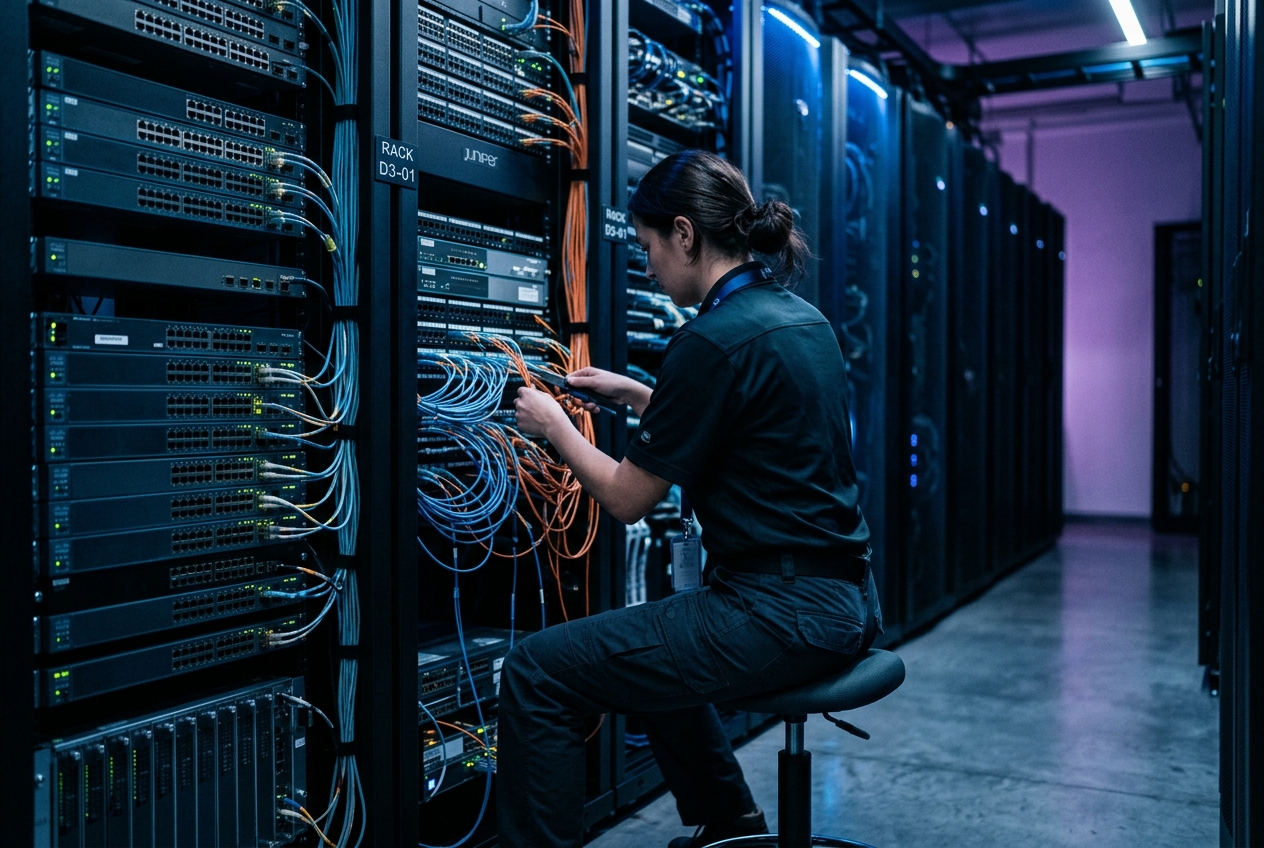
Routing is how traffic gets from one network to another. Routers make the decisions that let your local network reach the wider internet.
How a Router Moves Traffic
Routing tables, next hops and the default gateway.
Tap or hover a part to learn more.
Different subnets.
Routing connects distinct IP networks — here 192.168.1.0/24 and 10.0.0.0/24. Devices in different networks can only reach each other through a router.
Check your understanding
1. What does a router use to choose where to send a packet?
2. Where does traffic go when no specific route matches?
Keep learning
The core idea
- A router connects different networks and forwards packets based on destination IP.
- The routing table lists known networks and the next hop toward each.
- The default gateway is where traffic goes when the destination isn't local.
How an Access Control List Filters
Ordered permit/deny rules on an interface, ending in implicit deny.
Tap or hover a part to learn more.
Inbound or outbound.
An Access Control List is applied to a router or switch interface in one direction. It filters packets as they enter (inbound) or leave (outbound) that interface.
Check your understanding
1. How are ACL entries evaluated?
2. What happens if no ACL entry matches?
Keep learning
How it works in practice
- Static routing is manually configured; dynamic routing (OSPF, BGP) learns routes automatically.
- tracert/traceroute shows each router (hop) a packet passes through.
- A missing or wrong default gateway breaks all off-network traffic.
Common mistakes
- Confusing routing (between networks) with switching (within one).
- Setting the wrong default gateway.
- Assuming a routing problem when it's actually DNS or a firewall.
Why it matters for your career
Routing is the heart of CCNA and network engineering. Being able to explain how a packet reaches a website is a common interview opener.
Technical interview questions
- What is the difference between routing and switching?
- What is a default gateway?
- What is the difference between static and dynamic routing?
Practice questions
- What decision does a router make? (Next hop by destination IP)
- What shows each hop to a destination? (traceroute / tracert)
- Where does non-local traffic go? (The default gateway)
Where this fits in your networking journey
This is one concept in the Networking Fundamentals path, which leads into CompTIA Network+ and Cisco CCNA. When this clicks, review Spanning Tree (STP) and continue with Dynamic Routing (OSPF & BGP).
Practise with Missiora
- AI Interview™ — rehearse networking interview questions with scored feedback.
- Career Coach™ — build a fundamentals → certification → job plan.
- Job Intelligence™ — see which networking skills real adverts demand.